EU AI Act Article 50 and AI sales agents: what actually changed on 2 August 2026
Last verified: 2026-08-26
Summary
- Article 50's transparency rules became applicable on 2 August 2026. The Digital Omnibus delayed the high-risk rules. Not this one.
- An AI sales agent that writes and sends emails is in scope. The Commission's guidelines name e-mail as a covered channel and offer "an email generated by an AI agent sent to a natural person that features an AI label at the top" as a compliant example.
- "It's B2B, we're talking to companies, not natural persons" is not a defence. The guidelines reach cases "where a natural person may represent or act for a legal entity."
- The Article 50(1) duty falls on the provider who puts the agent on the market under its own name — not on the sales team using it. Three things make it yours: building in-house, white-labelling, or modifying and rebranding.
- Agents must disclose two things: that they are artificial, and the person on whose behalf they are acting. The second is rare in this category.
- Article 50 does not require an AI footer on your cold emails. The deployer text-labelling duty covers published text on matters of public interest, and the guidelines expressly exclude "private, interpersonal correspondence (for professional purposes)."
- Fines reach €15 million or 3% of worldwide turnover, whichever is higher — for SMEs and start-ups, whichever is lower.
- Article 50 is not permission to email anyone. GDPR and ePrivacy still decide whether you may send at all.
The short answer
If you run an AI agent that emails, calls or messages prospects in the EU, Article 50 applies to it as of 2 August 2026. But the practical question for a sales team is not "what do I add to my emails." It is "did my vendor build disclosure into the product, and can they show me where."
That is the answer. The rest is the primary text it comes from — because most pages ranking for this question are vendor blogs paraphrasing other vendor blogs, and several contradict each other on that exact point.
What Article 50 says, and who it binds
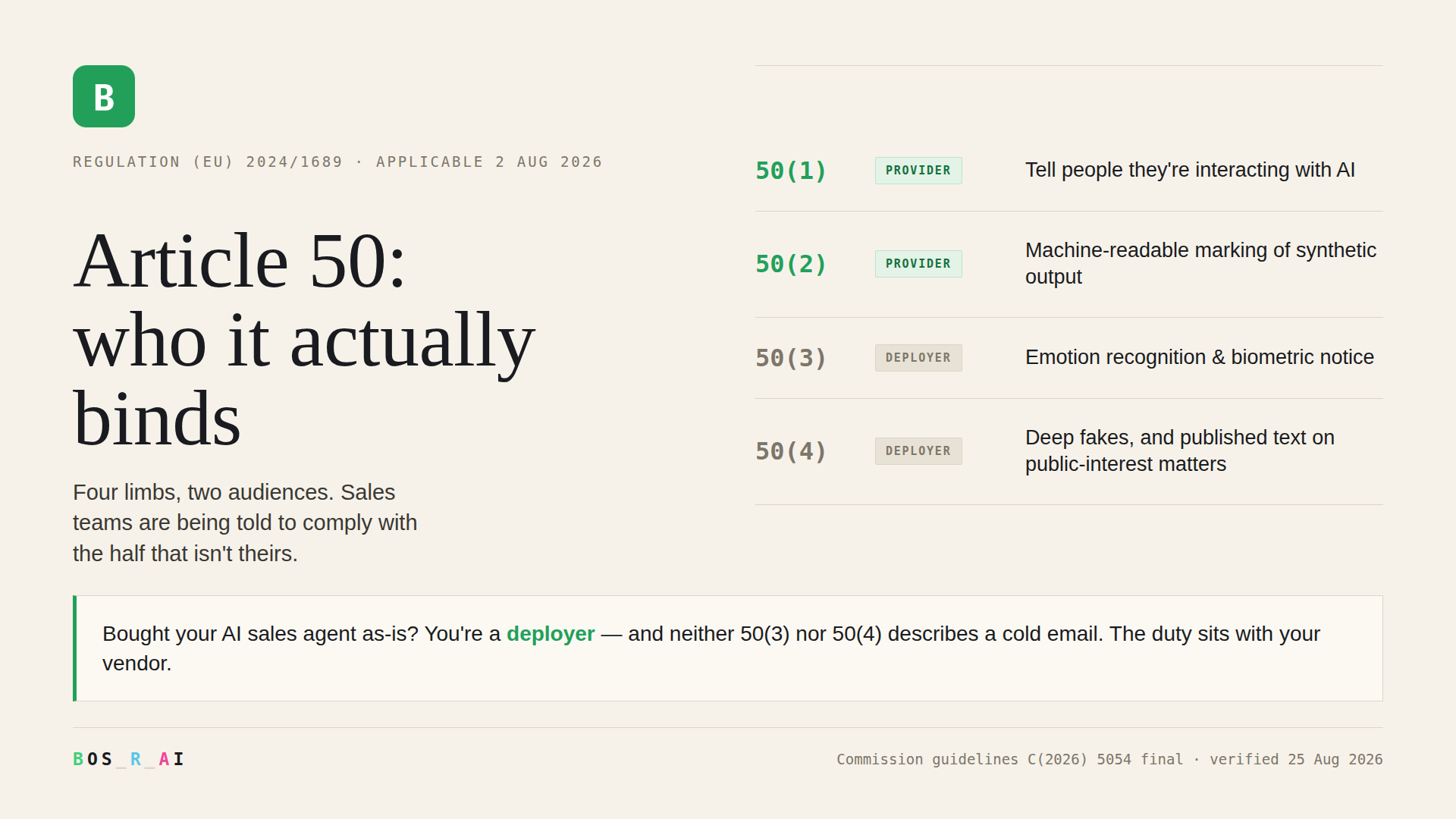
Article 50 of Regulation (EU) 2024/1689 has four operative limbs, binding different people:
| Provision | Binds | Requires |
|---|---|---|
| 50(1) | Providers | Design directly-interacting systems so people are told they are interacting with AI |
| 50(2) | Providers | Mark synthetic audio/image/video/text in a machine-readable, detectable format |
| 50(3) | Deployers | Inform people exposed to emotion recognition or biometric categorisation |
| 50(4) | Deployers | Label deep fakes, and AI text published to inform the public on matters of public interest |
That split matters more than anything else here. A company using a bought-in AI sales agent is a deployer — bound by 50(3) and 50(4) only. Neither describes a sales email.
Thirteen days before the rules applied, the Commission adopted its final Guidelines on the Article 50 transparency obligations (C(2026) 5054 final, 20 July 2026, 51 pages). Paragraph numbers below refer to it. A Code of Practice on Transparency of AI-generated Content was assessed adequate on 8 and 9 July 2026; adhering to it is voluntary.
Worth stating plainly: "sales," "outbound," "SDR," "prospect" and "cold" appear zero times across all 51 pages. What follows is the general rule applied to our case, and where that is arguable we say so.
Yes, email counts — the AI disclosure requirement for outbound
Some vendor pages say Article 50 covers only real-time chatbots; others say every AI-touched email needs a disclaimer. The guidelines answer it directly. Paragraph 30(ii) says people must be able to give the system input "via technical communication means including online interfaces, phone or e-mail, or directly." Paragraph 30(iii) extends direct interaction to "capabilities of the system to write and send messages to natural persons." Paragraph 36 then gives, as its worked example of visual disclosure: "an email generated by an AI agent sent to a natural person that features an AI label at the top."
Paragraph 31 covers AI agents as a category — in scope where they interact with people "in the execution of the tasks (e.g. making bookings, managing correspondence, negotiating or concluding contracts, executing purchases, etc)." Booking meetings and managing correspondence is a literal description of an AI SDR.
"They're a business, not a natural person" doesn't work
The commonest objection we hear is that B2B outreach targets companies, while Article 50 protects natural persons. Paragraph 31 closes it. Where a provider cannot know in advance whether the agent will meet a person, the agent "should be designed at the architecture level, and instructed, to disclose itself as such in every situation where it is reasonably likely that the agent may interact with a natural person (including where a natural person may represent or act for a legal entity)."
A VP of Sales reading a cold email at work is a natural person representing a legal entity. That parenthesis was written for this.
The related hope — that a professional audience makes the AI "obvious," triggering the Article 50 chatbot exception — is weaker than it looks. Paragraph 45 says the exception "should be interpreted restrictively," that general awareness chatbots exist "does not imply that they recognise them in interactions," and that obviousness is "limited to cases where there is almost no doubt left about the nature of the interaction." It names "the capability for advanced personalised interaction" as a factor that decreases obviousness. An outbound email is engineered to read as though a person wrote it to you specifically — the opposite of obvious, by design.
The obligation is your vendor's — until you make it yours
Article 50(1) is addressed to providers (para 28), and under Article 3(3) a provider is whoever puts a system on the market "under their own name or trademark." So if you bought your AI sales agent, disclosure has to be engineered into the product you bought. It is not a setting you were supposed to invent.
Three things move that obligation onto you, all from paragraph 11:
- You built it in-house. An organisation that develops an interactive AI system in-house and puts it into service in the Union under its own name is a provider — a homegrown agent on a general-purpose model is squarely this.
- You modified a vendor's system and shipped it under your own brand. "That company becomes a provider of the new system."
- You white-label. Same mechanism. Agencies reselling an AI SDR under their own brand should read paragraph 11 twice.
If none apply, your Article 50 exposure as a deployer is genuinely limited. Your commercial exposure is not — your domain, brand and list are still attached to whatever the agent sends. So the action is procurement, not legal: ask your vendor to show you the disclosure in the product, and get it in writing.
Check two things while asking, both paragraph 31. An agent must disclose "both their artificial nature and the person on whose behalf they are acting," and must disclose to the person instructing it "at key steps (e.g. at the point of authorisation, reporting, validation etc.)." That first requirement's second half is the one almost nobody has implemented. "I am an AI" is now common. "I am an AI acting for Acme Corp" is not.
What Article 50 does not require
Several ranking pages tell sales teams to add an AI-disclosure line to every EU campaign footer. As courtesy, fine. As law, wrong twice.
It is not what 50(4) says. That duty applies only to text "published with the purpose of informing the public on matters of public interest." Paragraph 131(i) defines "published" as accessible to "an indeterminate, fairly large number of unrelated, potential readers" — then excludes, by name, "private, interpersonal correspondence (for professional purposes)." A one-to-one sales email is not published. It is outside 50(4) entirely.
And a footer does not satisfy 50(2). That is a machine-readable marking obligation — metadata, watermarking, embedded provenance — binding the provider of the generative system, not you. Paragraph 63 confirms agent outputs count where they produce content "perceptible by natural persons." Human-readable text at the bottom of an email is not machine-readable marking and never was. (Paragraph 87 carves out a narrow business-to-business exception from marking, but its third cumulative condition requires output that "must not be intended to be shared outside the company," which outbound fails on its face. That reading is ours, not the Commission's.)
One more boundary, because it is the thing most often confused: Article 50 is a disclosure regime, not a permission regime. It says nothing about whether you may email a stranger. GDPR and ePrivacy decide that, and they did not change on 2 August. Article 50 compliance does not make unlawful outreach lawful. It makes lawful outreach honest.
Voice agents
Article 50(1) covers voice too. The guidelines' auditory example is a spoken statement at the start — "This is an AI-powered assistant" — with periodic reminders in longer calls. Paragraph 37 notes audio cues or tones alone are not sufficient. In the US, the FCC confirmed on 8 February 2024 that TCPA restrictions on "artificial or prerecorded voice" cover AI-generated voices. Whether that reaches B2B calls to mobile numbers is a separate question, and we could not verify a clear answer.
Are you in scope from the US or the UK?
Probably, if you deliberately prospect into the EU. Article 2(1)(c) catches providers and deployers in a third country where the system's output "is used in the Union." Paragraph 10 confirms this for providers, with a limit: "incidental, unforeseeable or unauthorised downstream use should not alone trigger" it. Paragraph 13 applies the mirror test to deployers, caught where the deployer "itself foresees dissemination and use of the AI outputs in the Union."
Uploading a list of German prospects and pressing send is the definition of foreseeing use in the Union. A US-only campaign that happens to reach one EU-based employee is closer to the incidental case.
The UK is not covered by the AI Act at all, and what UK law requires for B2B outbound is a question where we could not verify the position to our own standard. It is with counsel; we will publish when it clears.
What it costs, and who is actually enforcing
Article 99(4)(g) caps an Article 50 breach at €15,000,000 or 3% of total worldwide annual turnover for the preceding financial year, whichever is higher. For SMEs and start-ups, Article 99(6) flips it to whichever is lower — for a 40-person SaaS company, 3% of turnover is the ceiling, not €15M.
Now the part compliance-urgency marketing leaves out. Member States had until 2 August 2025 to designate the authorities that enforce this, and many did not. The AI Act Implementation Tracker, last updated 17 June 2026, classified 9 Member States as having both authorities clearly designated, 12 as partial, and 6 as unclear.
So: a real obligation, real penalty exposure, and an enforcement apparatus that is unevenly built. We would not bet a company on the third staying true — but anyone telling you enforcement is imminent everywhere is selling something.
Five things worth actually doing
- Ask your vendor, in writing, where the Article 50(1) disclosure lives in the product — and whether it names the party the agent acts for. Keep the answer.
- Work out whether you are a provider or a deployer. Built in-house, modified, or white-labelled means provider. Most teams have never asked.
- If a human genuinely reviews and sends, document it. Paragraph 30(iii) puts human-sent output outside 50(1) where the human is "the main interlocutor" — but warns that "the mere possibility for humans to intervene or review the AI system's outputs should not be used to circumvent" the rule. An approval queue nobody opens is not a defence.
- Check your voice agent opens with a spoken disclosure. Not a tone. Words.
- Don't let Article 50 distract you from the rules that govern your sending. Lawful basis, consent and suppression are where most outbound programmes are actually exposed.
What we could not verify
Three things, named rather than filled in: whether the FCC's AI-voice ruling reaches B2B calls to US mobile numbers; the UK position on B2B cold outreach under PECR, to a standard we would publish; and whether the paragraph 87 business-to-business marking exception could ever be read to cover outbound content — we think not, and we found no authority either way. We will update this page when any resolves, and date the change.
Where we stand
We build BOSRAI, an AI sales agent, so read the above knowing that. It discloses that it is AI, and it is measured on meetings booked rather than messages sent — a choice we made before Article 50 and would have made anyway.
We are not lawyers and this is not legal advice. It is a practitioner's reading of primary documents, every one linked so you can check our work. If we have read something wrong, we would rather hear it and correct it here. This piece is part of our forthcoming AI Outbound Compliance Handbook, covering the same ground across email, voice, messaging and data.
Last verified: 25 August 2026. Checked against the Commission's final guidelines (C(2026) 5054 final, 20 July 2026) and Regulation (EU) 2026/1744 (OJ, 24 July 2026).